All years
All authors
A credible AI business case starts with a defined business problem, not just an impressive capability. Learn how to connect AI use cases to measurable outcomes, realistic costs, adoption assumptions, risk, ownership, and ongoing ROI tracking.
Cost-benefit analysis helps organizations compare the expected costs of a decision with the value it may create. Learn how to build a useful CBA, test assumptions, account for risk and timing, and avoid the false precision that can weaken decisions.
Disagreement doesn’t have to weaken a business case. Used well, challenge exposes hidden assumptions, tests evidence, improves alternatives, and gives decision-makers more reason to trust the final case. See how KangaROI approaches stronger decisions.
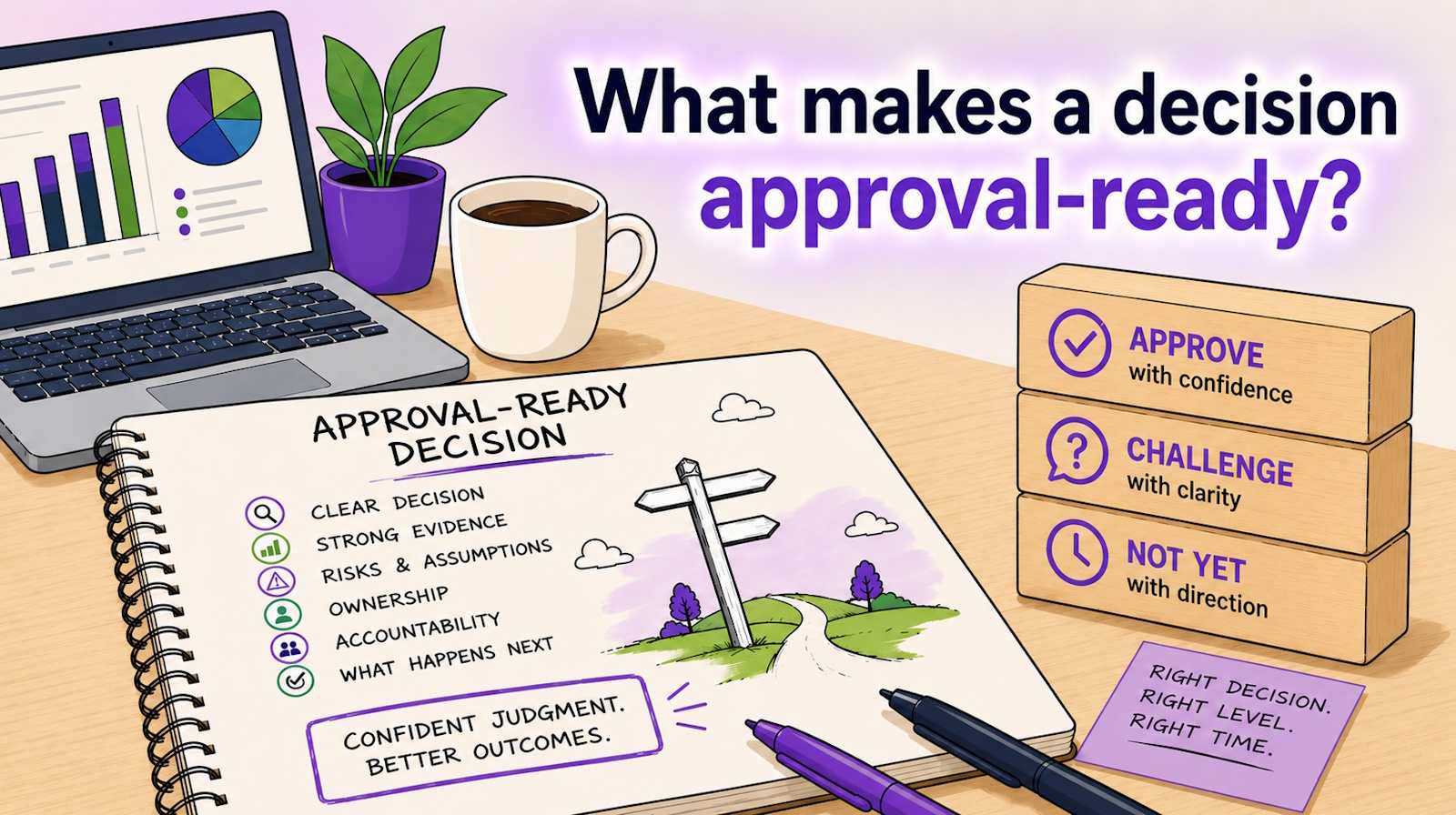
A decision can sound persuasive yet still be unready for approval. Use this practical framework to review the problem, options, evidence, financial logic, risks, ownership, and success measures before deciding whether to approve, revise, or reject.
What evidence should support an investment decision? Learn how financial data, operational inputs, stakeholder insight, benchmarks, risks, assumptions, and source records help teams make stronger, more credible decisions.
Smaller decisions don’t need heavyweight paperwork, but they still need structure. Learn how to create a lightweight business case that clarifies the decision, value, costs, risks, ownership, approval path, and tracking plan with KangaROI.
Most business cases are written to secure approval, which can encourage teams to smooth over uncertainty, weaken scrutiny, and defend a preferred answer. Here we explore how a Decision-first approach can improve the quality of the choice itself.
A decision record captures what was decided, why it was decided, who was involved, what evidence was used, and what assumptions were accepted. Learn how decision records reduce corporate amnesia, support accountability, and improve future reviews.
Fast decisions don’t need to be careless decisions. Learn how clear ownership, proportionate evidence, visible assumptions, appropriate approval paths, and simple tracking plans can help organizations move quickly without losing accountability.
Learn how to prepare an approval package for an investment decision, including the ask, recommendation, evidence, financial case, risks, assumptions, ownership, and follow-up needed to help approvers review confidently and move decisions forward.
AI enthusiasm can spark useful experimentation, but it’s not enough to justify investment at scale. Read why stronger AI decisions need clear objectives, ownership, risk awareness, prioritization, and post-approval measurement as initiatives multiply.
Most steering committees aren’t looking for reasons to approve your proposal; they’re looking for reasons it might fail. Learn how to present ROI in a way that builds trust, handles objections credibly, and improves confidence in investment decisions.
Most business cases are built with incomplete data, uncertain assumptions, and pressure to commit early. Learn how to build a credible, decision-ready business case using ranges, scenarios, and transparent assumptions without losing stakeholder confidence.
A completed document doesn’t always mean a decision is ready to approve. In this blog, learn what approvers need to see before they can confidently say yes, no, or not yet, and how to match the level of evidence to the size and risk of the decision.
Scenario modeling is widely accepted as essential, yet rarely used properly. Here we explore the practical and cultural barriers behind that gap, and how organisations can start using scenario modeling to make more confident, lower-risk investment decisions.
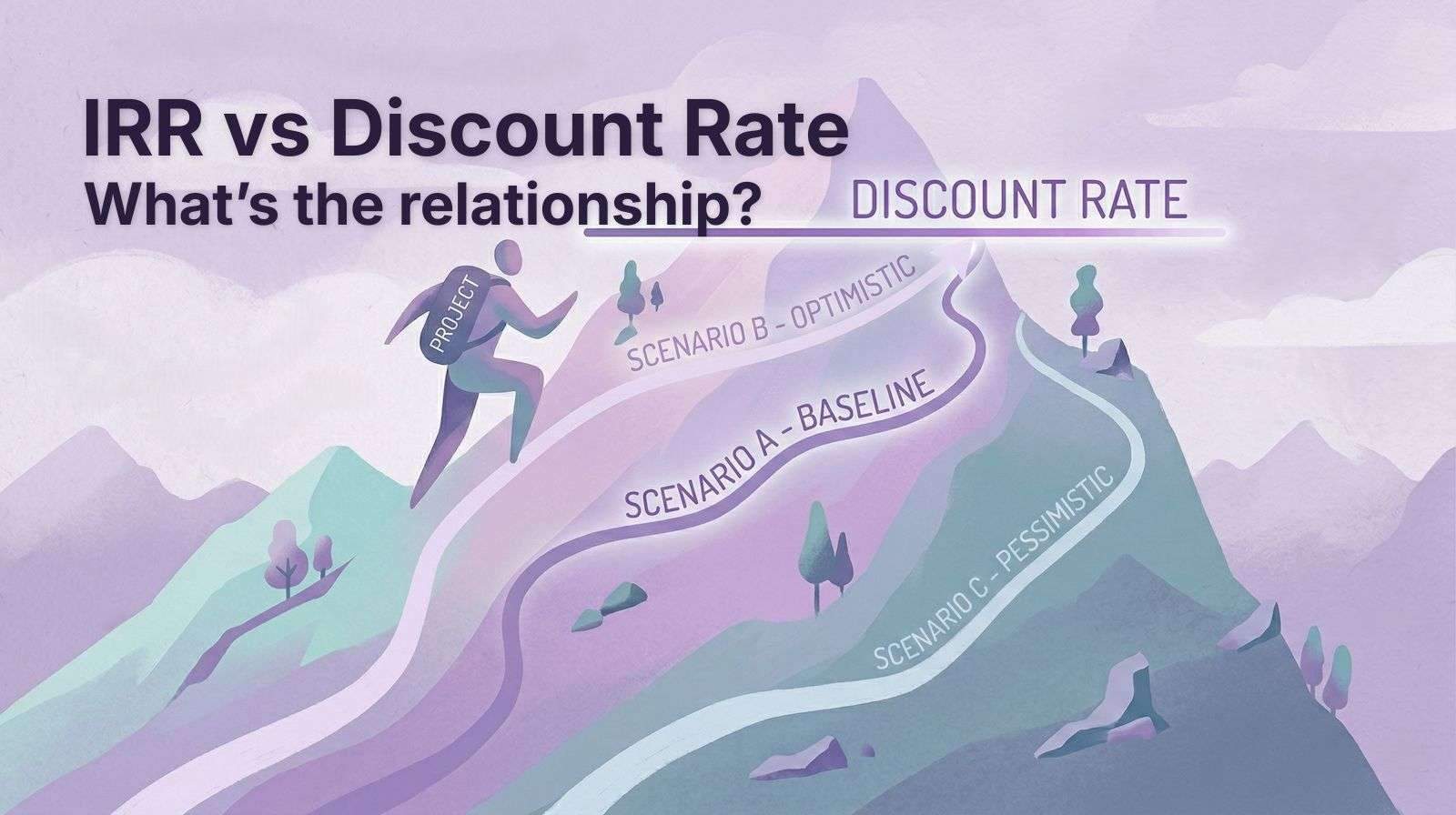
IRR and discount rate are often misunderstood or misused in business cases. This guide explains how they actually work together, why comparing them properly matters, and how to avoid common mistakes that can lead to poor investment decisions.
Opportunity cost reveals the hidden value of alternatives in your investment decisions. In this guide, learn how to include it in your business case to help you compare alternatives and make smarter, more confident choices.
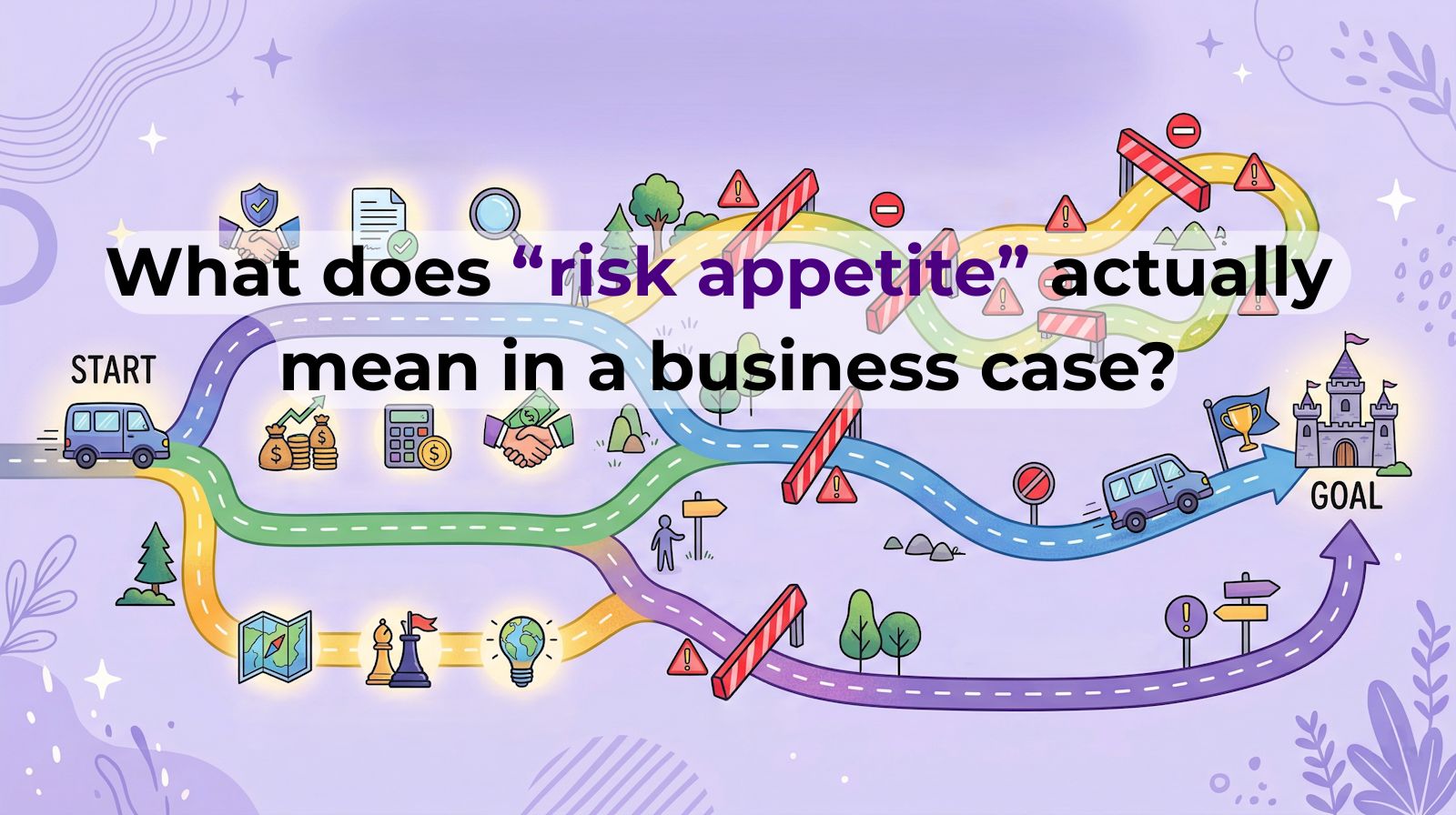
Risk appetite is often discussed but rarely defined in business cases. This guide shows how to translate abstract risk tolerance into clear thresholds, scenarios, and trade-offs that help to support you with confident, consistent decision-making.
Once a business case is approved, something strange often happens: the benefits that justified the investment quietly lose their owner. When no one is accountable for outcomes post-delivery, orgs stop learning whether their investments actually worked.
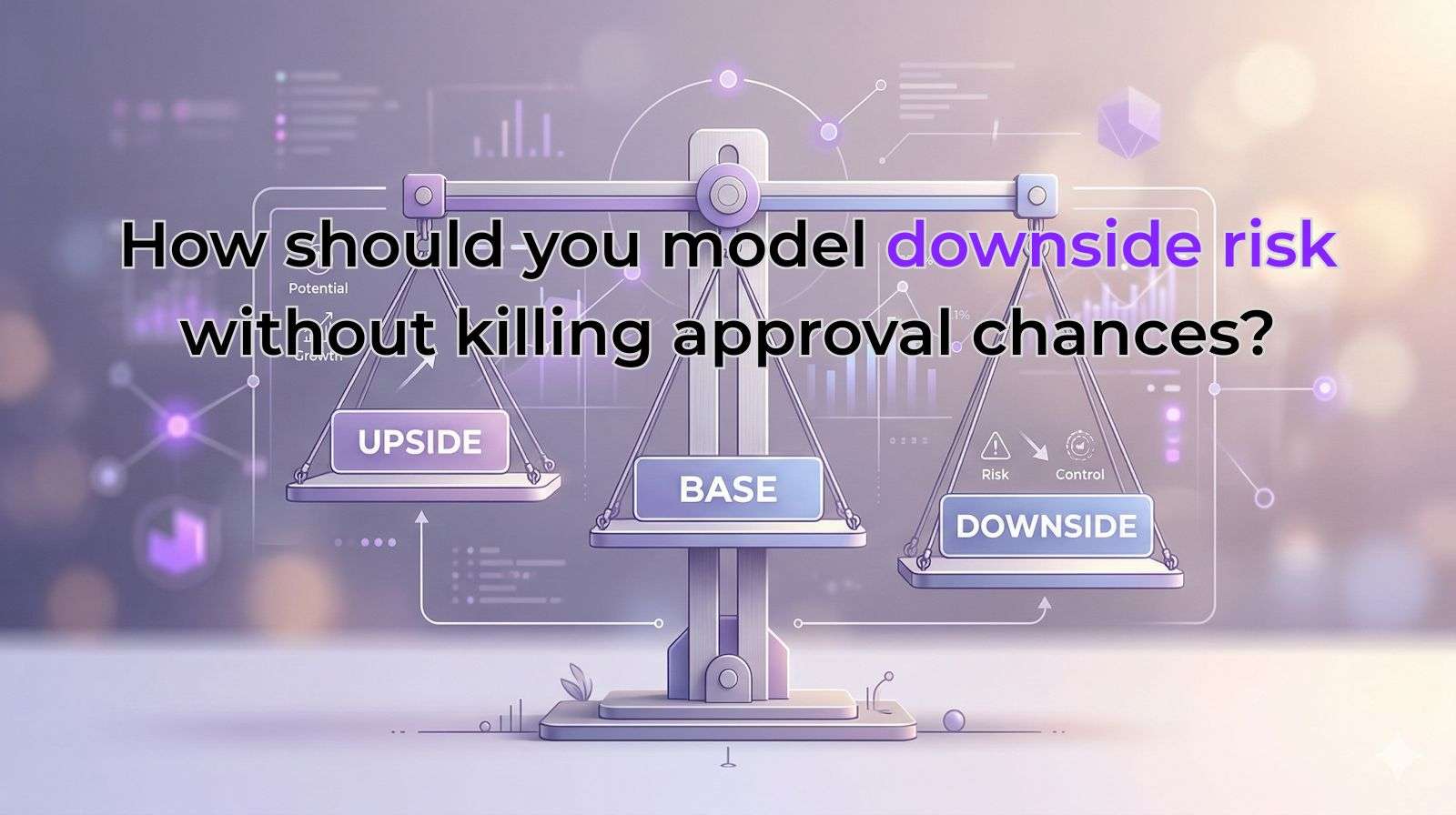
Modeling downside risk can feel like a fast track to rejection, but avoiding it creates fragile business cases. Learn how to structure downside scenarios in a way that builds credibility, strengthens decisions, and actually improves approval confidence.
CapEx vs OpEx investments often look comparable on paper, but they aren’t in reality, as timing, risk, and flexibility change the story. Learn how to compare ROI properly and make investment decisions that reflect real value and risk.
Most business cases track outcomes like ROI and cost savings, but these lagging metrics often arrive too late to act. Learn the difference between leading and lagging indicators, and how to design early signals that show if your business case is on track to deliver value.
Traditional ROI comparisons assume everything goes to plan, hiding meaningful differences in uncertainty between initiatives. Risk-adjusted ROI brings probability into the financial model, enabling more realistic comparisons and better investment decisions.
Portfolio-level ROI evaluates how your entire investment mix performs, not just individual projects. Learn how dependencies, resource constraints, and risk concentration shape total returns and how portfolio thinking leads to smarter capital allocation.
NPV, ROI and Payback Period are often treated as interchangeable ways to justify an investment. They are not, as each answers a different decision question. This guide explains when to use each and why using the wrong one creates false confidence.
Realized ROI (or Real ROI) focuses on the value actually delivered after approval, not the forecast used to justify the decision. This guide explains how to measure Real ROI, avoid common pitfalls, and close the gap between promise and outcome.
Most organisations treat ROI as something that matters only until approval. But when ROI is tracked after the fact, something interesting happens; incentives change, assumptions improve, and business cases become more honest from the start.
Hurdle rates and discount rates are often wrongly treated as being the same thing, but they serve very different purposes. In this guide, we explain the distinction, why it matters, and how confusing them can lead to distorted investment decisions.
Most risk registers look rigorous but fail to change decisions. This guide explains how to score probability and impact in a way that actually affects ROI, priorities, and approvals, without falling into false precision or compliance theatre.
Understand the difference between Payback Period and Discounted Payback Period, and why it matters in real business cases. Learn how each method works, where they help, where they mislead, and how to use them alongside other financial metrics.
KangaROI’s refreshed Business Case view highlights your key insights and provides dynamic calculations, while maintaining a consistent, familiar structure across the lifecycle. Built from customer feedback, it reflects how users build and consume business cases and lays the foundation for our always-present kAI assistant.
Understanding both tangible and intangible benefits helps you build realistic, credible, and complete business cases. Learn how to model, track, and connect both types of value in a way that decision-makers can trust.
Discover how sensitivity analysis reveals which assumptions truly shape your ROI. Learn how to test your model’s most critical variables, uncover hidden risks, and build a business case that stays strong even when conditions change.
ROI, ROIC, and ROE all measure “return”, but in very different ways. In this guide, we break down what each of these metrics means, how to calculate them, their limitations, and when to use them in your business case or investment analysis.
ROI doesn’t begin at go-live; it begins when people adopt the new processes and behaviors, so ignoring adoption makes business cases overly optimistic. Learn why factoring adoption into your forecasts creates business cases that actually deliver value.
Most business cases assume benefits arrive instantly, but the reality tends to be slower. Benefit ramping models how value builds over time, making forecasts accurate, credible, and defensible. Discover why timing is as important as totals in your ROI story.
Approval is only the beginning; tracking realized ROI ensures accountability and better decision-making. Learn practical steps for baselines, milestones, and benefit tracking, plus how tools like KangaROI make the process seamless.
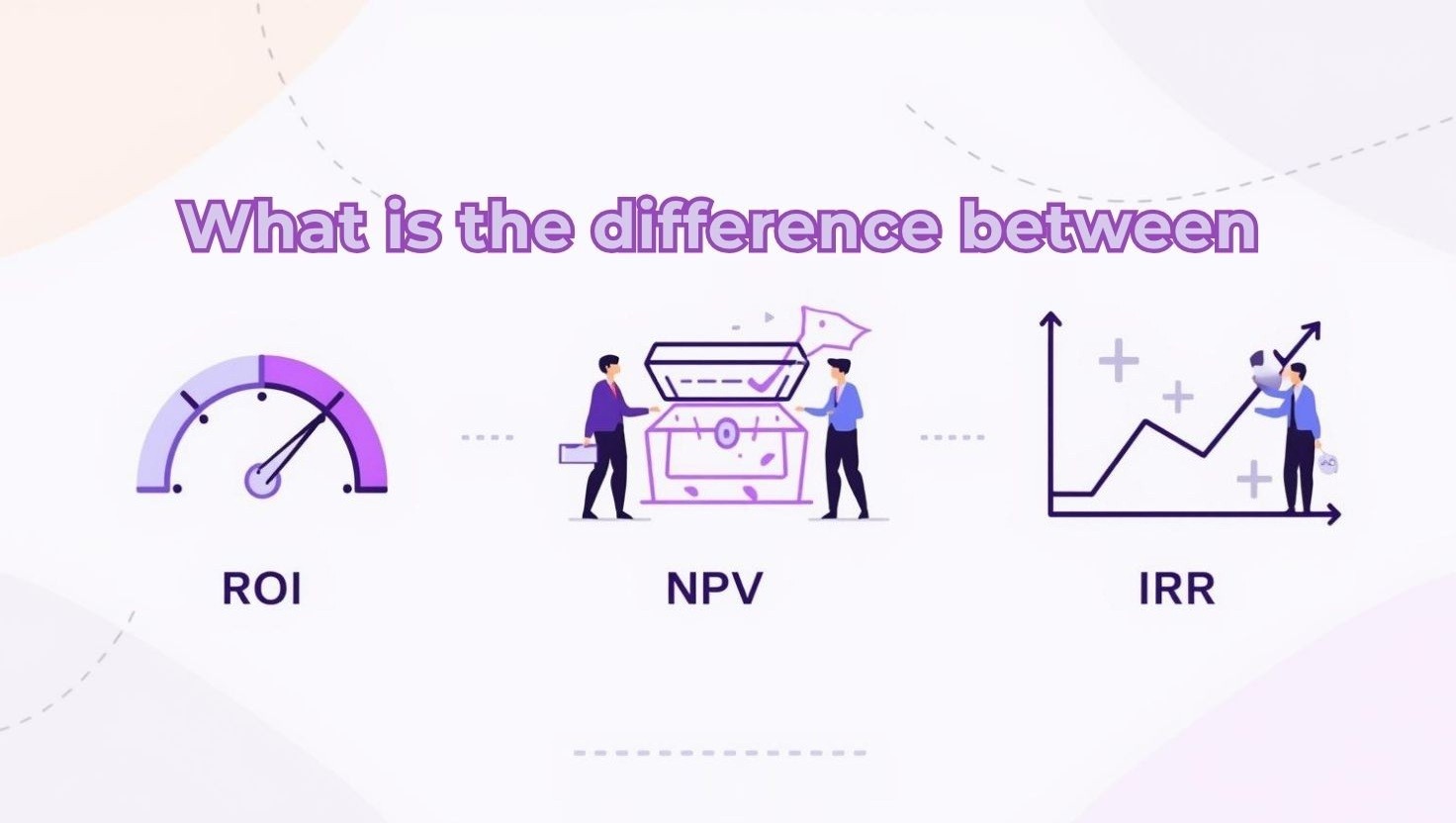
ROI, NPV, and IRR are often mentioned in the same breath, but each reveals something different about project value. ROI shows efficiency, NPV captures total worth, and IRR reflects growth potential. Here’s how to use them together in a stronger business case.
Every portfolio has them: projects that should have been ended long ago but somehow keep going. We explore the psychology, politics, and blind spots that keep failing initiatives alive, and how to build the discipline to stop them before they waste more resources.
Scenario modeling gives your business case more depth by testing best, base, and worst cases alongside strategic alternatives. Explore how changing assumptions impacts ROI, risks, and adoption, and show decision-makers the full picture before they commit.
Internal Rate of Return (IRR) is one of the most widely used financial metrics in business cases. Find out what IRR is, how to calculate it, where it adds value, and where it falls short, helping you to use it the right way.
ROI on paper rarely matches ROI in reality. Risk-adjusted ROI factors in probability and impact to reveal the true picture. Read the full guide to discover how it works and how you can be writing stronger, more resilient business cases.
Why do organizations keep making the same mistakes? Corporate amnesia. Business cases get filed away, reviews buried, and lessons lost. The result is wasted capital, eroded trust, and stalled progress. Read how to break the cycle and start remembering.
What happens after approval? The final Business Case Academy tutorial explores how governance and ownership turn approved business cases into real commitments with clear accountability. Learn how it is different from tracking, yet just as essential.
In the thirteenth Business Case Academy tutorial, we look at the critical role post-approval tracking plays in a winning business case. From building trust and accountability to driving continuous learning, it’s what ensures forecasts turn into real ROI.
We’ve refreshed the KangaROI website, but it’s more than just a new look. Discover our streamlined homepage and new feature pages for kAI, Risk Modeling, Scenario Modeling, and Real ROI. Discover how KangaROI helps you build smarter business cases.
Don’t leave your business case hanging. A clear, confident call to action turns interest into movement by telling decision-makers exactly what you want and why it matters. In the twelfth Business Case Academy tutorial learn how to make your business case drive action.
In this eleventh Business Case Academy tutorial, we explore how to integrate compliance into your business case from the start; identifying obligations, involving the right stakeholders, and avoiding last-minute surprises that stall approvals or derail delivery.
ROI is one of the most powerful numbers in business, yet often one of the least scrutinized as assumptions go unchecked with results rarely reviewed. But what if ROI was treated like financials; audited, tracked, and reconciled? It’s not as far-fetched as it sounds.
Vague goals don’t inspire action, whereas clear success metrics help align expectations, secure buy-in, and show you’re serious about delivering value. In the tenth tutorial of the Business Case Academy, learn how measurement builds credibility, and how to frame the right KPIs.
Even the best ideas need a clear plan. A solid roadmap shows you’ve thought through the how - not just the why - and builds trust with decision-makers. In the ninth Business Case Academy tutorial, learn how a practical, credible rollout plan makes your business case more persuasive.
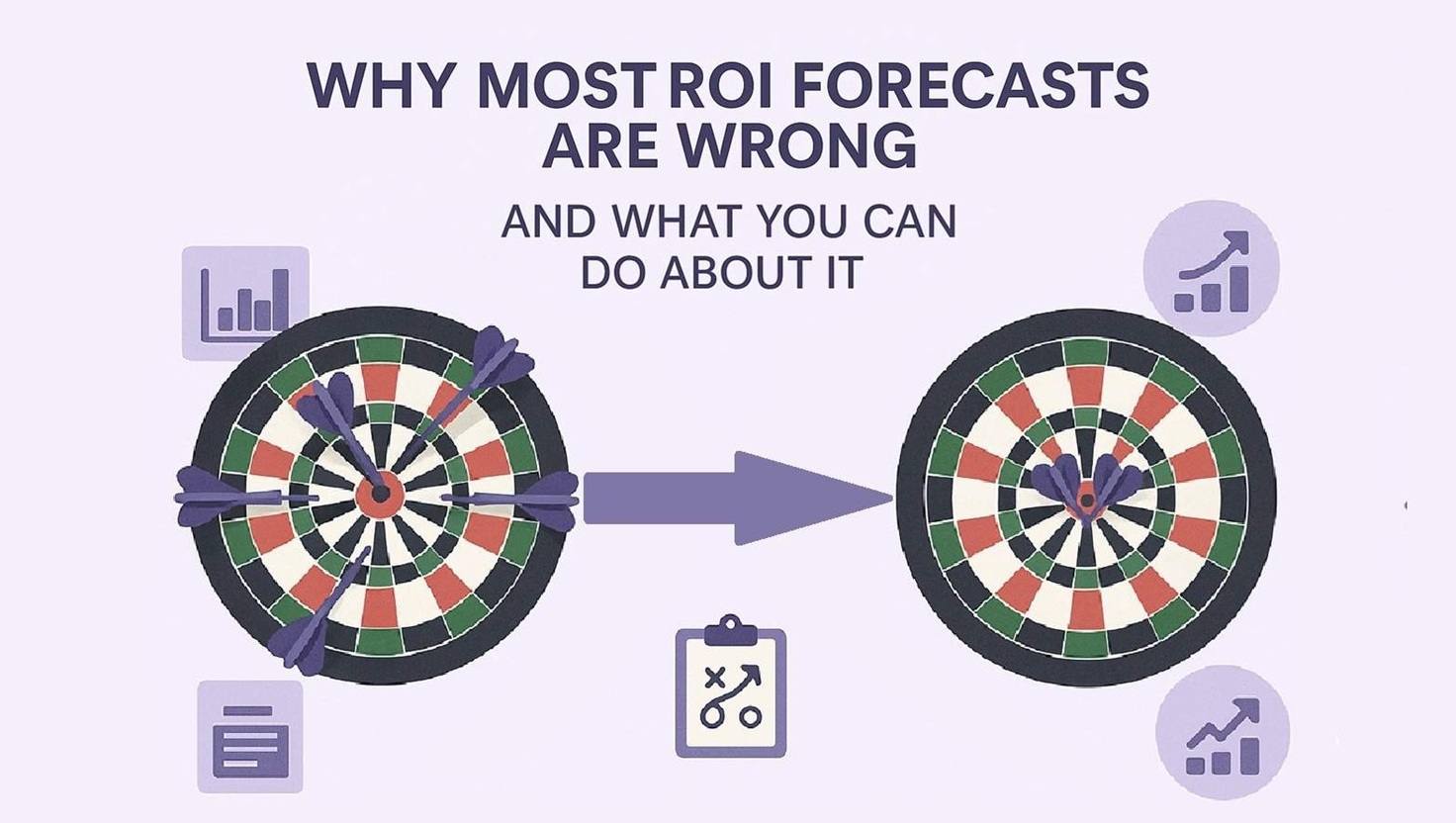
ROI forecasts are prone to error, yet we continue to rely on them to justify multimillion-dollar investments. Read as we explore why most ROI projections fall short, and what you can do to make yours more realistic, more credible, and more likely to get approved.
Strong business cases don’t jump straight to a single answer, they walk decision-makers through the thinking. In the eighth Business Case Academy tutorial we explore how showing alternatives and trade-offs builds trust, highlights rigor, and helps align on the best path forward.
The best business cases don’t just pitch ideas, they prove them. In the seventh Business Case Academy tutorial we explore how evidence, benchmarking, and performance data make your case more persuasive, actionable, and credible.
Spreadsheets are familiar and flexible, but when it comes to building and managing business cases, they often do more harm than good. From hidden errors to version chaos, read how they introduce silent risks at the exact moment you need clarity and control.
The strongest business cases don’t just highlight opportunities; they also address risks. In the sixth Business Case Academy tutorial, learn how to integrate risk analysis and mitigation into your business case for a more compelling, resilient, and most importantly winning, proposal.
Want your business case to stand out? In the fifth Business Case Academy tutorial we explore how proving a solid return on investment (ROI) can be the key to unlocking stakeholder buy-in. Learn how to calculate, communicate, and defend your ROI for a more persuasive business case.
Your business case is only as strong as your ability to explore options. With KangaROI’s new Scenarios feature, you can test assumptions, compare paths, and adjust your story in real-time - without touching a spreadsheet. Find out how it works here.
You can’t solve what you haven’t defined. A strong problem statement does more than describe an issue; it anchors your entire business case. In the fourth Business Case Academy tutorial learn how to clearly frame the challenges so your audience sees the value of solving them.
The third Business Case Academy tutorial explores how the most persuasive business cases don’t just justify a project’s cost, but directly support companies’ strategic goals, and that when stakeholders see alignment with overarching objectives, they’re more likely to approve the proposal.
A strong business case isn’t just numbers - it’s about connecting with decision-makers. Align your case with their priorities and pain points to build support and fast-track approvals. In this second Business Case Academy tutorial, learn to tailor your message for maximum impact.
Most business cases get filed away after approval, but that kills their potential to drive real, measurable ROI. Find out how keeping a business case “alive” keeps your investments aligned with ever-changing realities and ensures the value you promise is actually delivered.
The first tutorial in the Business Case Academy, a series aimed at helping with your business case creation begins at the beginning; the Executive Summary. But it’s so much more than just the beginning; learn why it’s so important and how to write the make-or-break section of your business case.
In investment analysis, understanding when you'll recoup your initial outlay is crucial. Here we delve into what the Discount Payback Period is, how to calculate it, discuss its significance, applications, and limitations, and equip you with the knowledge to make well-informed financial decisions.
Return on Investment (ROI) helps businesses measure profitability and make data-driven financial decisions. Whether evaluating marketing, software, or new projects, ROI ensures your money is working for you, so learn how to calculate and apply ROI effectively.
In 2025, getting funding for projects isn’t just about having a good idea - it’s about proving its value. With AI-driven insights and increased financial scrutiny, a strong, strategic business case is more critical than ever, so learn why.
Present Value (PV) and Future Value (FV) sound similar but have significant differences. Understanding those differences is the key to smart investing, so in the concluding part of the KangaROI Trilogy of Value Blogs, we explain the differences and why both matter.
Understanding the concept of Future Value is essential for smart financial planning. The second installment of the KangaROI Trilogy of Value Blogs explores why FV matters, and what it can and can’t be used for, for both businesses and individuals.
Without a solid understanding of Present Value, we won’t have the foundations to assess any investment opportunity, so here we’ll explain what PV is, why it matters, and how to calculate it, as well as touch on a few of its limitations.
How to deal with project delays was identified as the number one concern in customer feedback, so we are now launching our solution… Milestones! In this blog we’ll explain how this addition will take your project planning and cost management to the next level, giving you even more control and clarity over your projects.
Understanding discount rates is essential when evaluating investments so in this blog post, we’ll guide you through what discount rates are, why they matter, the different types, how to calculate them, and how businesses use them.
A lifetime in sales means that KangaROI Co-Founder Devin Halperin is perfectly placed to guide you on how to purchase software, break down the types of purchases and explain why non-purchases can sometimes be the best option.
The Time Value of Money is a key concept in understanding how to appraise investments. In this blog post, we’ll break down what TVM is, why it matters, and why you should be factoring it into investment decisions.
Value Selling is a concept familiar to many, but Value Buying is more of a mystery. Here we’ll take you behind the scenes of sales, help you understand how you should be making purchases, and why you should be Value Buying.
NPV is one of the most widely used financial metrics for evaluating investment opportunities and potential projects. Whether you're a vendor or buyer, a budget owner overseeing 100 projects, or a PM of a single project, understanding NPV is crucial for making informed, value-based decisions.
We’re thrilled to announce the launch of the KangaROI Blog—your new go-to resource for expert insights, practical advice, and all the latest news in software management. Read more here.