IRR and discount rate show up in almost every business case, yet they’re one of the most consistently misunderstood pairings.
You’ll often (wrongly) see them used interchangeably, or worse, compared without context. A project has a “high IRR”, so it must be good. Another uses a “conservative discount rate”, so it must be safe. To the untrained (non-Economist…) ear, they might sound like confident, informed conclusions, but the problem is that neither of those statements actually means much on its own.
IRR and discount rate aren’t competing metrics (in fact, they’re designed to work together), and when they’re misunderstood or misapplied, decisions start drifting away from reality, business cases stop reflecting actual risk and value, and this is where many investment decisions quietly go wrong.
IRR tells you the return; the discount rate tells you the benchmark
ℹ️ - Before going further, it’s worth a quick refresher (we’ve covered both IRR (Internal Rate of Return) and Discount Rates in more detail elsewhere, but here’s the short version):
At a simple level, IRR and discount rate answer two different questions.
IRR asks: What rate of return does this project generate?
Discount rate asks: What rate of return do we require, given risk and alternatives?
Now individually, they’re useful, but together, they determine whether a project makes sense. Here’s how they interact in practice:
➕ If IRR > Discount Rate → the project creates value
🟰 If IRR = Discount Rate → the project breaks even
➖ If IRR < Discount Rate → the project destroys value
That’s it; that comparison is the core decision rule.
But in real-world business cases, this clean relationship gets muddied surprisingly quickly, and some common ways this gets misunderstood are:
Treating IRR as a “score” rather than a relative measure
Using a fixed discount rate across very different types of projects
Ignoring how risk should influence the discount rate
Comparing IRRs across projects without aligning assumptions
The key takeaway from this is that IRR only has meaning in relation to the discount rate, as without that context, it’s just a number.
Why IRR on its own is misleading
It’s tempting to focus on IRR because it feels intuitive, a higher percentage looks better, it’s easy to communicate, and it fits neatly into a slide. But IRR, on its own, hides more than it reveals. Here’s where it breaks down:
📏 It ignores scale: A project with a 40% IRR on a small investment may deliver far less value than a project with a 15% IRR on a large one. This is because IRR doesn’t tell you how much value is created, only the rate of return.
🔄 It assumes reinvestment at the same rate: IRR calculations assume that interim cash flows can be reinvested at the same IRR, which is rarely realistic, but can artificially inflate the attractiveness of projects with early returns.
🔀 It struggles with non-standard cash flows: Projects with multiple inflows and outflows can produce multiple IRRs, or misleading results altogether.
⚠️ It says nothing about risk: Two projects can have identical IRRs, but completely different risk profiles.
This is where most business cases go wrong, as they treat IRR as a standalone indicator, instead of anchoring it to risk and required return. The result is that decisions may look rational on paper, but don’t hold up in practice.
The discount rate is where risk actually lives
If IRR tells you what a project delivers, the discount rate defines what you need it to deliver. This is where risk, uncertainty, and opportunity cost come into play, so in theory, the discount rate should reflect:
Cost of capital
Risk of the project
Availability of alternative investments
Strategic priorities
In practice, it’s often treated as a fixed number across all business cases, and that’s a problem. Common discount rate mistakes are:
Using a single corporate hurdle rate for all projects
Not adjusting for project-specific risk
Ignoring changes in market conditions
Treating the discount rate as a finance-only input
When the discount rate is too low, risky projects look artificially attractive, and conversely, when it’s too high, good projects get rejected. Neither of those outcomes is neutral, as both distort decision-making, so a more realistic approach is to:
Adjust the discount rate based on risk level
Use scenario modelling to test sensitivity to different rates
Align the rate with how the organisation actually evaluates trade-offs
The important thing to realise here is that the discount rate isn’t just a number; it reflects how your organisation thinks about risk.
IRR vs Discount Rate: how they actually work together in decisions
In theory, the decision rule is simple: compare IRR to the discount rate, but in practice, that’s rarely comprehensive enough. A single comparison only tells you what happens if everything goes to plan, but what you really want to understand is how robust that decision is when things change.
Let’s look at an example where our base case has an IRR of 18% and a Discount Rate of 12%. Now, at first glance (and if we did no further analysis), we’ll have put a nice big tick next to our first rule (“If IRR > Discount Rate → the project creates value”), as it feels like a no-brainer.
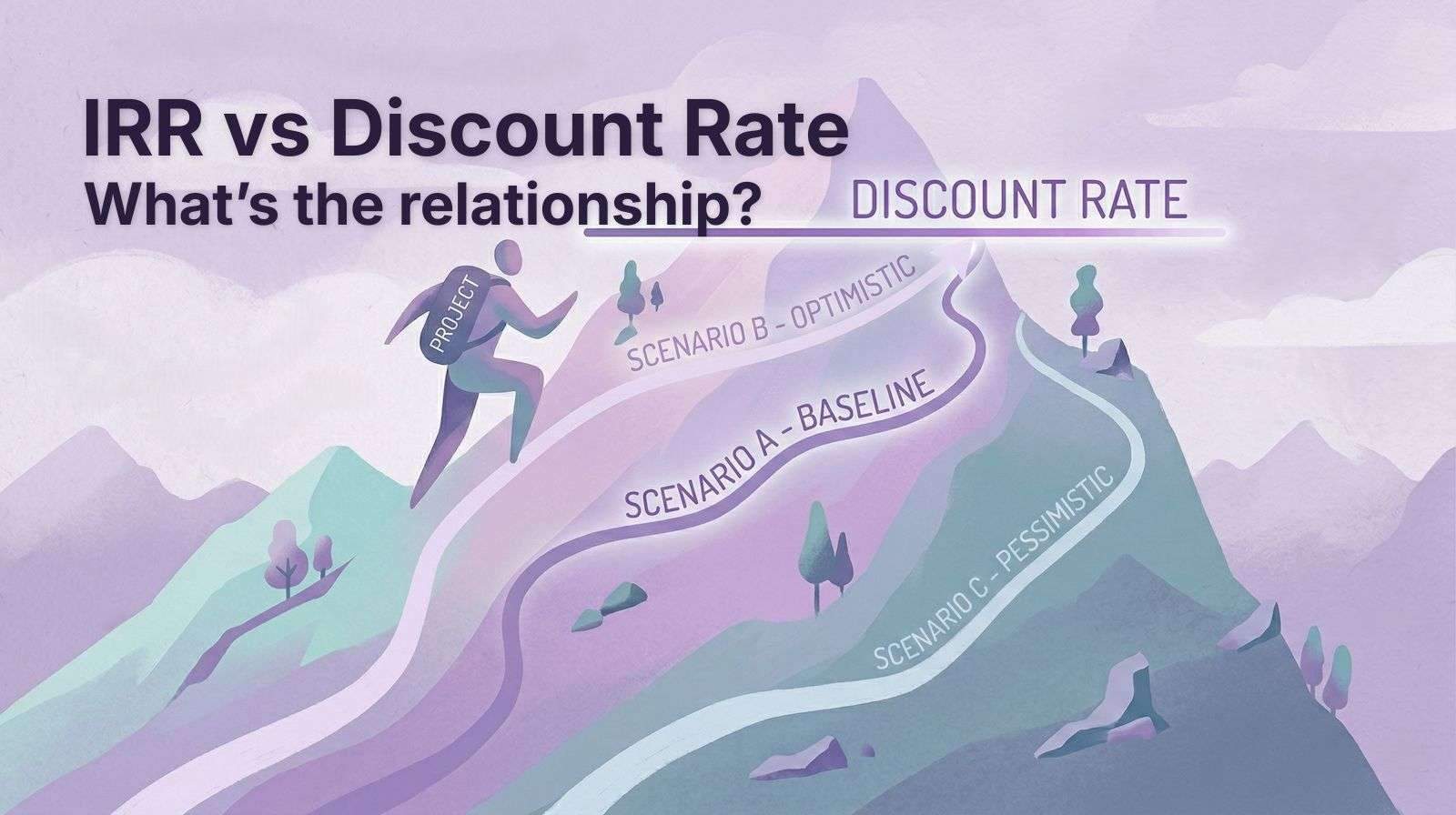
But a strong business case doesn’t stop there, as it’ll then test how that relationship holds under pressure. Here we may find that the downside scenario has an IRR of 11% (so we start twitching, as our third rule - “If IRR < Discount Rate → the project destroys value” has become relevant), while on the happier side of the ledger, the upside scenario has an IRR of 24%, which is double that of our discount rate, so a strong performance and comfortably above the threshold.
Now we find that the conversation starts to shift, as we consider:
How likely is the downside?
How far can performance drop before the case breaks?
Is the upside worth the risk?
and that shift is the difference between a static comparison and a risk-aware decision.
Where many business cases fall short (with the result being a false sense of certainty) is that:
They present a single IRR figure
They assume a fixed discount rate
They ignore variability in outcomes
So the way to counter this is to ensure you:
Compare IRR to the discount rate across multiple scenarios
Incorporate probability and risk, not just averages
Understand how close the project is to the threshold
The closer IRR is to the discount rate, the more sensitive the decision becomes, so that’s precisely where you’ll find that better modelling has the biggest impact.
Practical ways to use IRR and discount rate correctly
Understanding the relationship is one thing, but applying it consistently is where most organisations struggle, so here’s how to make it practical:
🔗 Always pair IRR with the discount rate: Never present IRR in isolation; it should always be shown relative to the required return.
🚩 Align the discount rate with risk: If there’s higher uncertainty, use a higher discount rate, while if there are expected to be stable, predictable returns, use a lower discount rate. Although this sounds obvious, it's rarely applied consistently.
🆚 Use scenarios, not single-point estimates: To expose how robust the investment really is, test how IRR behaves under:
Different cost assumptions
Delayed benefits
Reduced adoption or impact
🔎 Look beyond the threshold: Don’t just ask if IRR exceeds the discount rate, as the real value comes from knowing by how much, how sensitive the gap is, and what needs to go right for it to hold.
➕ Combine with other metrics: Strong business cases don’t rely on one metric; they build a coherent picture so IRR shouldn’t stand alone. Make sure you pair it with:
NPV (to understand value creation)
Payback period (to understand timing)
Risk-adjusted ROI (to understand uncertainty)
Practical takeaway: turning theory into better decisions
If you take one thing away, it’s this:
IRR doesn’t tell you if a project is good. It tells you how it performs against a benchmark. To improve your business cases:
Define the discount rate clearly and justify it
Test how IRR behaves under different scenarios
Focus on the gap between IRR and discount rate, not just the headline number
Treat risk as a core input, not an afterthought
When you do this well, decisions become more grounded, so you move from “this looks good” to “this holds up under pressure.”
Conclusion
IRR and discount rate aren't competing concepts; they’re two halves of the same decision. When used properly, they create a clear, structured way to evaluate investments, but when misunderstood, they create false confidence, misaligned comparisons, and poor decisions, so the difference comes down to how they’re applied.
By anchoring IRR to a well-defined, risk-aware discount rate and testing that relationship under real-world conditions, business cases become more than just numbers; they become tools for making better, more confident decisions.


