Clarity
Understand exactly what's being decided
Make the problem, recommended option, required commitment, and what approval will authorize explicit.
Approval is often treated as the final step in a decision process; the document is complete, the recommendation is written down, the numbers are included, and the meeting is booked.
But despite all those things, that doesn’t necessarily mean the decision is ready to approve.
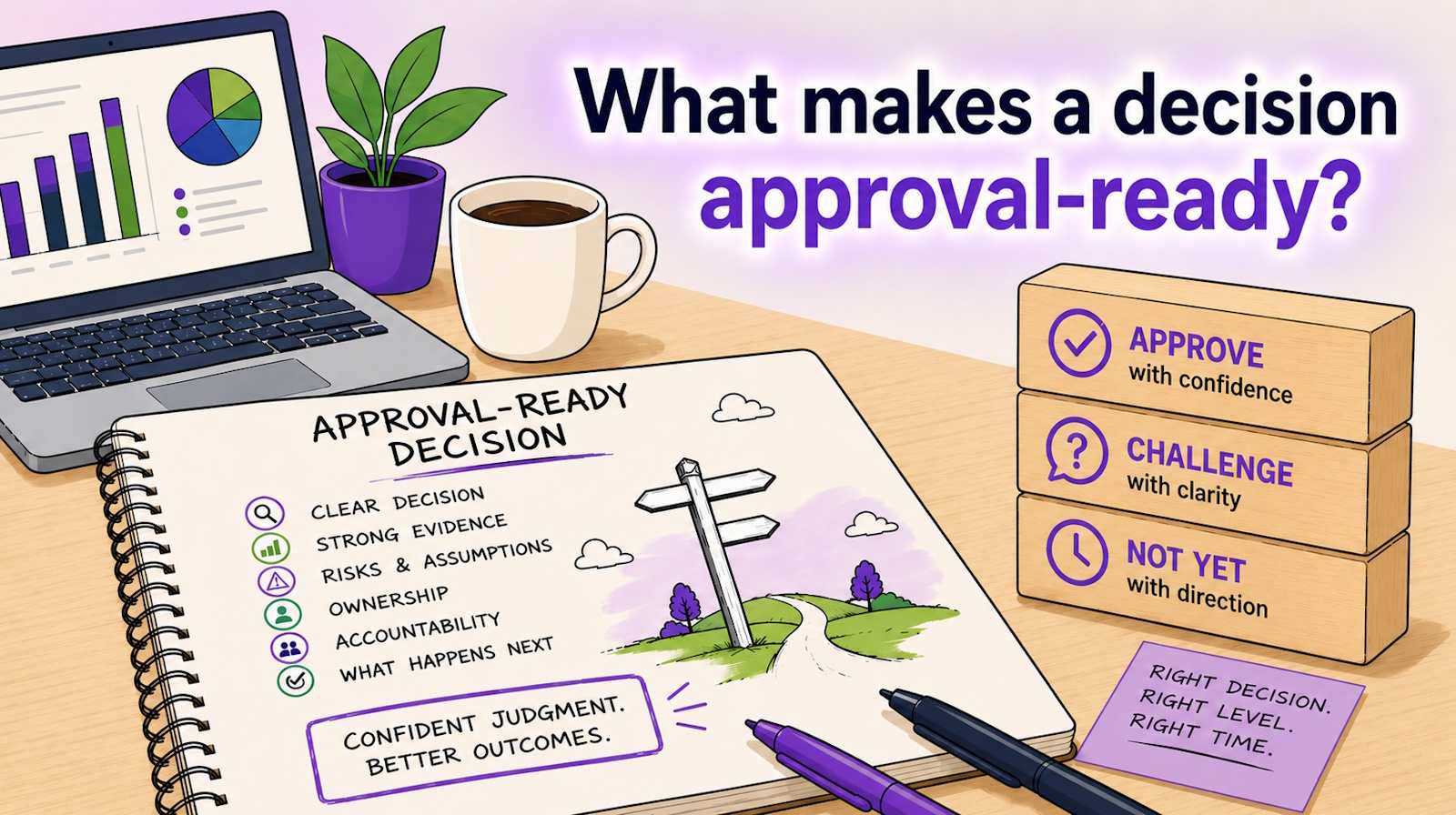
An approval-ready decision is not simply one that has been documented. It’s one that gives an approver enough clarity, evidence, ownership, risk awareness, and accountability to make a confident judgment.
That judgment might be “yes”, it might be “no”, it might even be “not yet.” But in each case, the approver should understand what is being decided, why it matters, what evidence supports it, what risks remain, and what happens next.
The goal isn’t more paperwork; it’s to make the decision easier to assess, easier to challenge, and easier to track.
One of the most common mistakes in approval processes is assuming that more information creates a stronger decision.
It often doesn’t, as a long business case can still be unclear, a detailed slide deck can still avoid the real risk, a financial model can still hide weak assumptions, and a completed template can still leave the approver uncertain about what they’re actually being asked to approve.
Approval readiness isn’t about volume; it’s about quality. A decision becomes approval-ready when the right information is clear enough for the level of decision being made.
For a smaller operational decision, that may just mean a short explanation of the problem, the recommended action, the expected benefit, a high-level cost, the owner, and the next step.
For a major investment decision requiring executive sign-off, approval readiness may require full financial modeling, risk analysis, scenario modeling, stakeholder input, governance, and post-approval tracking.
The standard should change with the magnitude of the decision. A lightweight decision shouldn’t be forced through an enterprise-level process, and equally, a strategic investment shouldn’t be waved through based on a few optimistic bullet points.
The real test comes down to one, simple, practical question:
Does this decision contain enough clarity and evidence for someone at the appropriate level to approve, challenge, or reject it responsibly?
Before an approver can evaluate a decision, they need to understand what the decision actually is. Now that sounds blindingly obvious, but many approval requests are surprisingly vague. They describe a project, a problem, a vendor, a budget request, or a desired outcome without clearly stating the decision being made.
👉 e.g.
⚠️ “We need approval for the customer success platform project.”
That leaves far too much open. Is the decision to buy a specific tool? Approve budget? Start procurement? Replace an existing system? Launch a pilot?
A clearer version would be:
📌 “We are seeking approval to purchase and implement a customer success platform for the mid-market segment, with an expected first-year cost of $180,000, owned by Customer Operations, and measured against renewal rate, account coverage, and expansion pipeline improvements.”
That gives the approver a much stronger starting point.
An approval-ready decision should make clear:
🔍 What is being decided: Is this a funding decision, vendor decision, prioritisation decision, policy decision, resourcing decision, or implementation decision?
📊 Why the decision matters: What problem, opportunity, risk, or constraint is driving the need for action?
📌 What option is being recommended: What is the preferred path, and what alternatives were considered?
🧭 What approval would authorize: Will approval release budget, start work, assign resources, trigger procurement, or commit the organization to a specific outcome?
The important thing to realise is that clarity actually protects both the approver and the team asking for approval. Without it, people can think they’ve agreed to one thing, then later discover they approved something broader, narrower, riskier, or more expensive than they realized.
A decision doesn’t need perfect evidence to be approval-ready. In fact, most organizations make decisions with incomplete information, as in reality costs shift, benefits are uncertain, adoption depends on behaviour, and risks evolve. Waiting for perfect certainty before making a call would therefore likely stop any progress altogether.
But the evidence should be strong enough for the scale, risk, and reversibility of the decision being made.
The key point is proportionality; a $5,000 software decision for a small team shouldn’t require the same evidence package as a multi-year, company-wide transformation program, while a major investment shouldn’t be approved with the same level of scrutiny as a minor process improvement.
For smaller decisions, evidence might just need to be a quick one-pager, while larger decisions may need to include:
🧮 Financial modeling: current and expected line item costs, benefits, ROI, payback, NPV, or other relevant measures.
ℹ️ Context: why this matters now, which stakeholders will be affected (so should be consulted), and the approval flow.
📊 Outcome logic: a clear connection between the action being approved and the outcomes expected.
🔍 Options analysis: evidence that reasonable alternatives were considered, and why the proposed approach was selected.
⚠️ Risk and assumption review: the main things that could make the decision underperform, and the mitigations that will be put in place for them.
This is where many approval requests struggle, as they present the recommendation confidently, but the supporting evidence is thin.
For example, a proposal might claim that a new tool will save 20% of team time, but fail to explain where that estimate came from, who validated it, or what needs to change operationally for the saving to be realized.
Missing those pieces of information doesn’t automatically make the decision wrong, but it does make it harder to approve confidently.
Approval-ready decisions make evidence visible, showing what’s known, what’s assumed, what’s uncertain, and what still needs validation. The goal isn’t bureaucracy; it’s achieving defensibility at the right level.
Approval-ready means clear enough to approve, challenge, or reject responsibly.
Understand exactly what's being decided
Make the problem, recommended option, required commitment, and what approval will authorize explicit.
Be able to defend the recommendation
Show the financial logic, options considered, expected outcomes, risks, assumptions, and what remains uncertain.
Know what happens after approval
Make accountability, governance, delivery ownership, measurement, and follow-up visible before the decision is made.
Approval readiness is not about having the longest document. It is about having enough decision quality for the level of commitment being requested.
Approval readiness becomes harder to manage when decisions are built across scattered documents, spreadsheets, slide decks, and email threads, as important context can be missed, assumptions can be buried, risks can sit separately from the financial model, and ownership can be unclear. And once a decision is approved, the evidence behind it is often difficult to track back to the original commitment.
This is where structured decision tools like KangaROI can help.
Rather than treating the business case or approval document as the starting point, KangaROI helps teams build the decision itself first, including the problem, evidence, options, outcomes, financials, risks, governance, and tracking plan.
From there, the appropriate level of outputs such as approval packages, business cases, decision briefs, and tracking plans can be generated from the same structured decision data, based on the decision level.
That matters because approval readiness isn’t just about producing a better document. It’s about giving approvers a clearer, more evidence-based view of the decision, while helping the organization retain visibility into what was approved, why it was approved, who owns it, and whether the expected outcomes are achieved.
Before submitting a decision for approval, ask whether the approver has enough information to make a responsible judgment. A useful approval-readiness check includes:
🔍 Decision clarity: Is it clear what’s being approved and what the approval will authorize?
⚖️ Proportionality: Is the level of detail appropriate for the size, risk, and reversibility of the decision?
📌 Rationale: Is the reason for the decision clear and relevant?
📊 Evidence: Is the recommendation supported by enough reliable information?
🧭 Options: Have reasonable alternatives been considered and documented?
🧮 Financials: Are the expected costs, benefits, and value clear enough for the decision level?
⚠️ Risks and assumptions: Are the main uncertainties visible, assessed, and owned?
👥 Governance: Are the requester, owner, sponsor, approver, and stakeholders clear?
👤 Accountability: Does someone own delivery, measurement, and follow-up?
📈 Tracking: Is a plan required to compare expected outcomes with actual results?
The point isn’t to make every decision heavy; it’s to make every decision clear enough for the level of commitment being requested.
A decision is approval-ready when someone can confidently approve it, challenge it, or send it back for more work, and that requires more than just a completed document.
It requires clarity about what’s being decided, evidence that supports the recommendation, visibility into risks and assumptions, clear ownership, and accountability for what happens after approval.
For smaller decisions, that can be lightweight and practical, but for larger decisions, it needs to be more structured and defensible. The goal isn’t more process, but better decisions.
When organizations focus on approval readiness, they improve the quality of individual decisions, and when they structure decision information consistently, they also create better visibility across teams, portfolios, investments, risks, and outcomes.
That’s where approval becomes part of a stronger decision-making system, rather than just a gate or a box to tick.


